
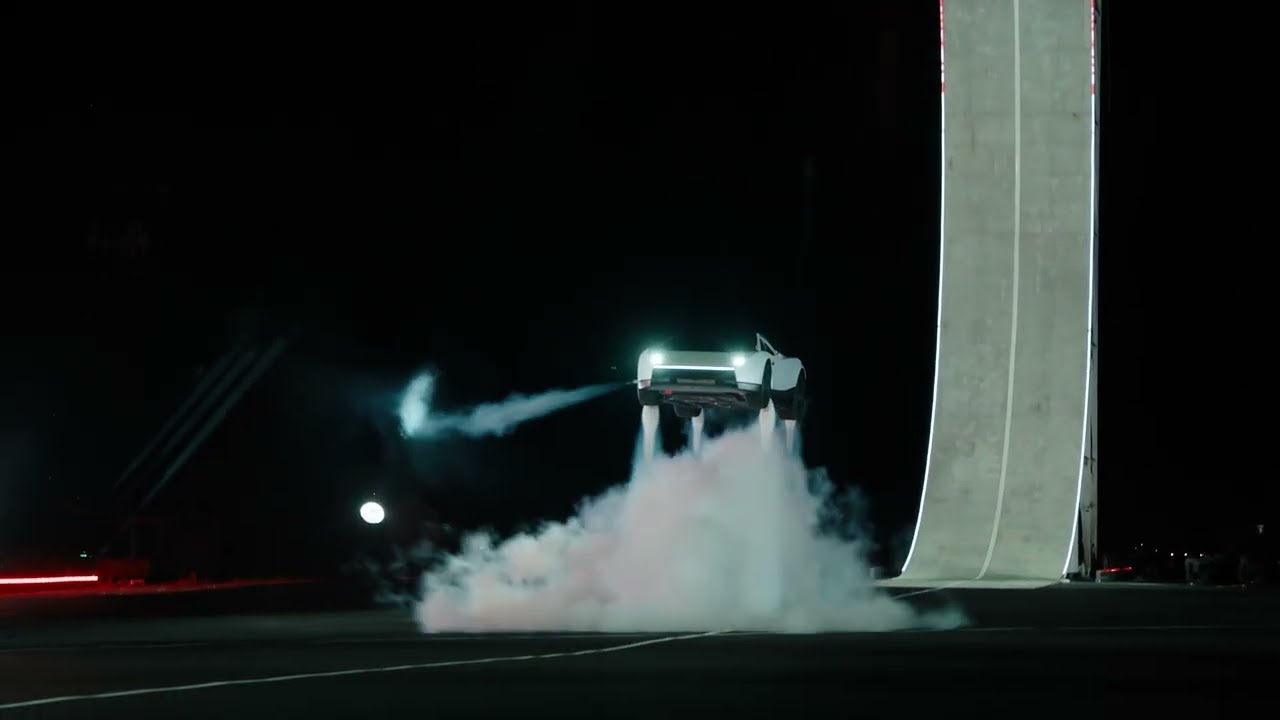
Tesla’s latest Roadster has left the ground. Whether it will make the leap from spectacle to a useful consumer product is the more demanding question.
At the 15 October demonstration, the car performed airborne manoeuvres. Elon Musk now targets production in 2028. MotorTrend’s first-hand report, including interviews with Tesla’s designers, describes the vehicle as a prototype intended for production, with decisions still unresolved.
Why the flying-car promise deserves scepticism
Stored pressurised gas provides thrust. That makes a brief lift-off technically different from sustained, practical flight. A useful product needs to answer how long it can operate, how it is replenished, what happens when a system fails and where owners may use it. Tesla’s own page distinguishes optional equipment and says Rocket availability varies by region.
Those are tests of repeatability and usefulness. A controlled demonstration cannot establish everyday safety, running costs or permission to operate around other road users. Our assessment is that a specialist collector’s machine is a more plausible outcome than routine airborne transport. There is no evidence that justifies saying no version will ever be manufactured.
Five promises worth remembering
- Roadster timing: unveiled in 2017 with a 2020 target; the latest target is 2028.
- A million robotaxis in 2020: Musk’s 2019 prediction did not materialise on that timetable. Later robotaxi activity does not fulfil a missed 2020 deadline.
- Semi timing: production was originally expected in 2019; first customer deliveries arrived in December 2022.
- Cybertruck pricing: the $39,900 starting figure announced in 2019 became a $60,990 base-model estimate at the November 2023 launch. That is a comparison of announcements, not today’s sale price.
- Full self-driving hardware: Tesla said in 2016 that new cars carried the necessary hardware. Its current consumer FSD (Supervised) guidance still requires an attentive driver and says it does not make the vehicle autonomous.
The record supports demanding evidence before treating another deadline as a delivery date. It also demands accuracy: delayed products and changed specifications are different from products that were never made.
The stock: a dated market snapshot
At 3:51pm EDT on 16 October 2026, TSLA was quoted at $353.67. That is 21.36% below the $449.72 close on 31 December 2025. The reported 52-week trading range was $297.38 to $498.83.
The year-to-date figure is the share-price change, calculated as ($353.67 ÷ $449.72 − 1) × 100. This is an intraday snapshot, not a closing quote. It describes performance; it does not establish that one product reveal caused the move.
Tesla. Frames from its official The Ramp | Roadster and The Kickflip | Roadster videos, 15 October 2026.
Sources
- Tesla Roadster: current caveats
- MotorTrend: first-hand prototype inspection and Tesla interviews
- Reuters: 2028 target
- Tesla FSD support: supervision required
- Tesla’s 2016 hardware press release (archived press kit)
- Tesla 2019 shareholder-meeting transcript
- Consumer Reports: missed autonomy timelines
- Time, 2017: Roadster and Semi targets
- Tesla: 2022 Semi deliveries
- Reuters: Cybertruck launch-price comparison
- Tesla: The Ramp, official footage
- Tesla: The Kickflip, official footage
- Stock Analysis: 52-week range
- Yahoo Finance: 31 December 2025 closing baseline


